

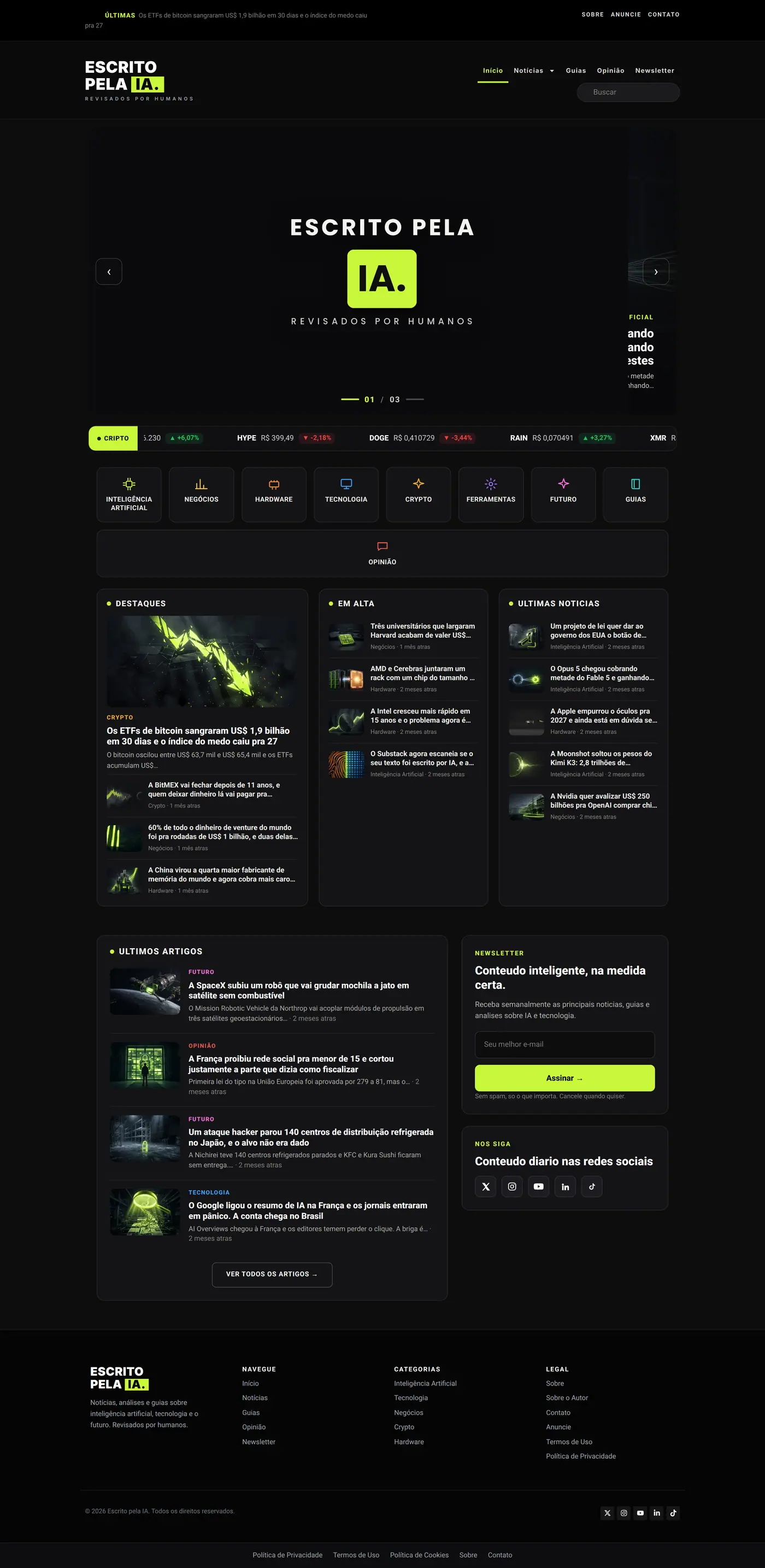
Escrito pela IA
A technology portal that says in its own name how it is made.
- Client
- In-house product
- Sector
- Media · Technology
- Year
- 2026
- Scope
- Concept · Identity · Development · Editorial automation
The problem
Everyone uses AI to write and almost nobody admits it. The result is a market full of generic copy pretending to be reported, and a reader who distrusts all of it.
I wanted to test the opposite: put the method in the publication's name and see whether transparency works as positioning rather than as an excuse.
What I built
The editorial process is published on the About page in five steps: story selection, a minimum of two sources with primary-source verification, drafting against a voice guide, human review, and a cover image generated in the house style. The rules are written down too: never invent a quote, a number or a source; rumours are labelled as rumours; corrections are flagged.
Voice is the part automation doesn't touch. Headlines carry judgement and marked opinion, because neutral wire-copy headlines are what make an automated portal read like a robot. The pipeline delivers a draft with its SEO package and cover ready; deciding what goes live is mine.
Automation is in the process, not the voice
What the machine does well is monitor sources, rank relevance and assemble structure. What it does badly is hold an opinion. That is the division of labour, and it is why the copy does not read like a rewritten press release.
Public proof, not a slide in a deck
It is the same system I offer to clients, running in public every day, with the method on the door. A client who wants to understand what editorial automation means can open the site and watch it work.
Inside


Project documentation
Art direction
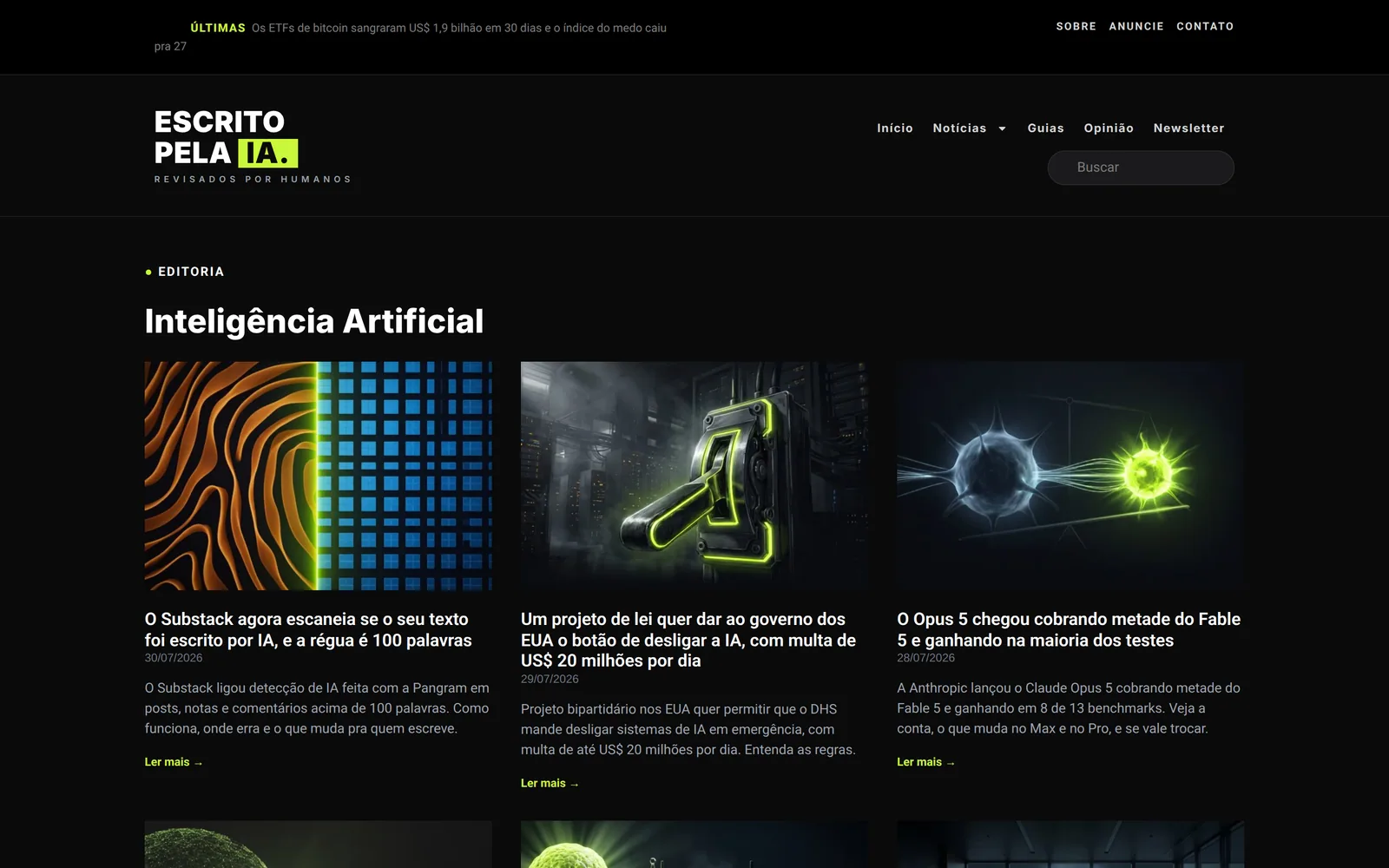
A portal about AI that could not look AI-made. I cut the genre’s whole visual vocabulary — purple gradients, circuit brains, floating particles — and kept black, one acid colour, and newspaper hierarchy. The lime is the only element allowed to shout, and it marks category, not decoration.
Typography
- Aa Inter
The whole interface, headline to caption. One family, resolved by weight and size.
A single family was a performance decision: every extra family is another request blocking first paint, on a site publishing dozens of pages a week.
Palette
- #0D0D0D Background
- #15181B Card
- #C9F73A Accent
- #3AA0F7 Category
- #2FD4C4 Category
- #A06BFF Category
- #F0A92E Category
- #E2564A Category
Nine category colours come from one variable. The section paints the card, the tag and the active link without any component carrying the rule.
Why this stack
WordPress, but used as a database rather than an editor: the pipeline writes the whole post through the REST API — title, body, Rank Math SEO package, generated cover — and the post is born as a draft. The human part is approving. I chose WordPress here rather than static precisely because it already solves authorship, review, scheduling and AdSense without me writing any of it.
Details
Draft, never direct publish
The API is allowed to create, not to publish. It is an architectural lock, not a discipline one: even if the pipeline fails badly, nothing reaches a reader without someone clicking.
Covers composed, not rolled
The generated image goes in as the background of a template with a mask, a category tag and the wordmark in a fixed position. Two stories on the same subject come out looking alike on purpose.
In numbers
What was built, counted on the site itself.
editorial process steps, published openly
sections: AI, tech, business, hardware, crypto, future and tools
of articles carry the method disclosure in the byline